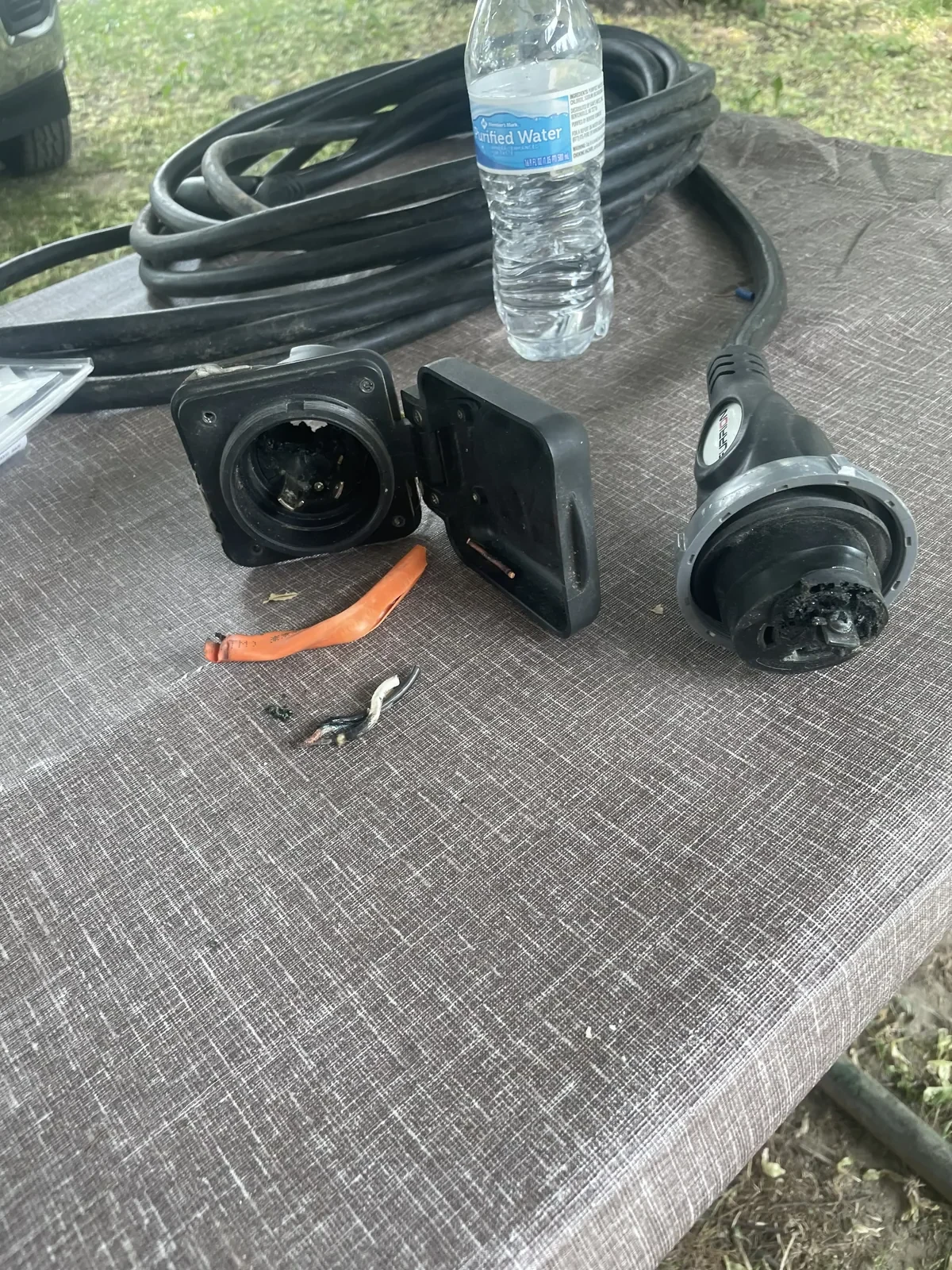
If you own an RV and use 50-amp shore power, there’s a 20% chance you’ve already had a plug meltdown incident — melted contacts, discolored blades, a smoky smell at the pedestal — and never known why. That’s not a scare tactic. It’s a stat from Mike Sokol’s RVelectricity owner survey, corroborated by the annual fire-loss data the National Fire Protection Association (NFPA) publishes on vehicle fires.
I know this because it happened to my family in 2019. Our RV caught fire from a shore power cable failure — the kind of near-miss that gets you into a garage the next weekend trying to figure out why nobody had built the obvious fix.
Here’s what’s actually going on inside your 50-amp plug when it melts, why it’s so much more common than the RV industry admits, and what actually prevents it.
The problem is mechanical, not electrical
The RV shore power system uses standardized plugs — a NEMA TT-30 for 30-amp cords and a NEMA 14-50 for 50-amp. Both are designed to carry serious current: 30 amps at 120V is 3,600 watts of continuous load, and 50 amps at 240V is a full 12,000 watts. That’s about the same as your entire home’s electrical service running through one plug.
That amount of current is manageable — as long as the electrical contacts inside the plug stay tight. When they don’t, physics takes over. Resistance builds at the loose contact, resistance generates heat, heat softens the surrounding plastic, softer plastic loosens the contact even more, and the whole thing runs away until you have a melted plug — or worse, a fire.
The question is: why do the contacts loosen in the first place?
Almost every case comes down to one culprit: mechanical strain on the cable.
How cable strain causes a “melted” plug
Every time you plug into shore power at a campground, the weight of the cable pulls downward on the inlet. Add wind, rain, someone walking through the site and kicking the cord, or the natural bounce of the coach — and that pull becomes a repeated tug on the pins holding the plug together.
Over time, the internal contact springs lose their grip. Not by a lot — maybe a millimeter of separation. But that millimeter is enough to introduce a resistance rise. And a resistance rise turns into heat under high current.
You wouldn’t see this happen. There’s no spark. There’s no bang. The failure is invisible, silent, and cumulative. By the time you notice something — a hot cord, a burning smell, a discolored plug — the damage has been building for weeks or months.
That’s why NFPA reports $129 million in average annual RV fire property loss in the U.S., with the number rising in recent years. The RV market has grown; the number of nights-under-shore-power has grown; but the underlying plug design hasn’t changed since 1938.
The peak-fire-season data
The U.S. Fire Administration (USFA) tracks RV fires by month. Their 2018–2020 report shows a stark seasonal pattern: 38% of all RV fires happen between May and August — exactly when RVs are most heavily used and shore power connections stay plugged in for weeks at a time.
The peak month is July.
That’s not a coincidence. It’s what you’d predict if you understood the failure mode. The longer your cord stays plugged in, the more thermal-mechanical cycling it experiences, and the more chances the contact interface has to loosen. Weekend RVers who plug and unplug frequently often see fewer meltdowns per year than full-time snowbirds who leave a single connection for weeks or months.
Why surge protectors don’t help
Every experienced RVer knows to use a surge protector or, better, an Electrical Management System (EMS) like Progressive Industries or Hughes Autoformers. These devices are excellent at what they do: monitor incoming voltage, detect open-neutral or reverse-polarity wiring, and cut power if something dangerous happens on the campground’s side of the cable.
But they don’t prevent the failure I’m describing. Surge protectors and EMS units live between the cable and the RV. The failure happens in the cable itself — specifically at the plug-to-inlet junction. When your plug’s internal contacts loosen from cable strain, the surge protector still sees the same 240V and doesn’t trip. It only sees a problem after the plug has melted, arced, or caught fire — by which point the damage is done.
Strain Guard is complementary to your surge protector. It prevents the mechanical failure at the source. Your EMS protects you from grid-side problems. You need both.
What actually prevents plug meltdown
Three things, ranked from most to least effective:
- Eliminate the mechanical strain on the plug. This is what Strain Guard does. By taking the cable weight and movement off the plug-inlet connection, the internal contacts stay tight, resistance stays low, and heat never builds. Passive, mechanical, and 60 seconds to install.
- Inspect your shore power cord regularly. Once a month, unplug it and look at both ends. Discoloration, black soot, melted plastic, or a burning smell means retire the cord immediately. Not “next week” — immediately. A discolored plug is a plug that’s already been running hot.
- Support the cable weight yourself. If you don’t have Strain Guard, at minimum use a heavy hook or bungee to lift the cable off the plug so the plug isn’t bearing the cord’s weight. This is a partial solution — it doesn’t stop wind and coach movement — but it’s better than nothing.
The RV industry has tolerated this failure mode for decades because the standardized plug design predates modern high-amperage RV electrical loads. The right long-term fix is a new inlet standard with mechanical strain relief built in. Until that happens, aftermarket strain relief is the answer.
What to do right now
If you’ve experienced a melted plug or hot cord, retire the cord and inlet immediately. Don’t try to repair it. The internal damage is impossible to inspect visually, and the failure mode is progressive — the next meltdown will happen faster than the first.
If you haven’t experienced one yet, congratulations: statistically, you’re in the 80% who hasn’t caught the mechanical problem yet. But the design flaw is still there. Adding Strain Guard to your existing cord takes 60 seconds and prevents the initial contact loosening from ever happening.
You can also help the RV community by talking about this openly. The industry is slow to admit design problems that affect its own customers. Every RVer who understands why plugs melt is one fewer near-miss.
If your cord is showing any signs of heat damage — even mild discoloration — retire it now. If it’s not, inspect it monthly and consider strain relief.
Sources
- National Fire Protection Association (NFPA) — U.S. Vehicle Fire Trends and Patterns Report (annual property loss and injury data)
- U.S. Fire Administration (USFA) — Recreational Vehicle Fires in Residential Areas (2018–2020), monthly incidence data
- Mike Sokol / RVelectricity — Reader survey data on shore power plug damage; ongoing coverage at rvelectricity.com
- NEMA (National Electrical Manufacturers Association) — TT-30 and 14-50 plug standards
- NHTSA — Recall coverage of RV manufacturers regarding shore power inlet failures
Published July 7, 2026. If you have experience with a melted RV plug — or research on RV shore power failure modes — email me at matthew@strainguard.com. I’m always looking for better data.